The Leadership
Transition
Helping Managers Become Leaders
Schedule a 15-20 Minute Consultation
Not everyone promoted to a managerial role is fully thinking and acting like a leader. Without significant help, less than two in ten managers will successfully transition into their expected role.

Overview
Now, more than ever, organizations look to their formal and informal leaders as the key to remaining competitive in today’s environment. Unfortunately, the practice of promoting people into leadership roles because of their technical skills or abilities, does not guarantee that they will meet the expectations and needs of the organization.
This White Paper describes why this issue is a critical problem facing organizations today, some of the common traps and suggestions on how to improve the leadership transition process.
The Critical Transition into the Leadership Role
Every organization needs more and better leaders to compete in today’s environment. That’s why organizations work so hard to rapidly transition successful individual contributors into leadership roles where they can have a greater impact. These roles can be formal management (having direct reports) or informal leaders (having no direct reports), either way they have the potential for increased leverage and impact, and for purposes of this paper, “leader” will represent both groups.
With an increasing number of baby boomers retiring, and the ever increasing pace of change, it is critical that organizations help make the transition of individual contributors to higher impact “leader” roles as efficient, effective, and rapid as possible. The question is, are they?
Emerge Leadership Group research shows that when individual contributors successfully make the transition to effective leadership, they contribute at a level that is two-to-three times higher than leaders that have not sufficiently made this transition. Unfortunately our research also shows that 84% of leaders in organizations today are not performing at fully transitioned capacity.
Schedule a 15-20 minute consult with an Emerge Consultant to discuss the gaps in your organization’s leadership approach.
The Stages of Impact-Contribution Expectations
To describe and measure individual contribution and impact in organizations, we’ve developed a model based on initial research at Harvard in the mid-1970s by Professors Gene Dalton and Paul Thompson.1 In an eight-year study of how professional contribute in organizations, Dalton and Thompson found that they high performers transitioned through at least three, and in some cases, four different Stages of Impact over the course of their careers. A brief summary of these transition Stages identified by Dalton and Thompson, which we call the “Stages of Impact,” are as follows:
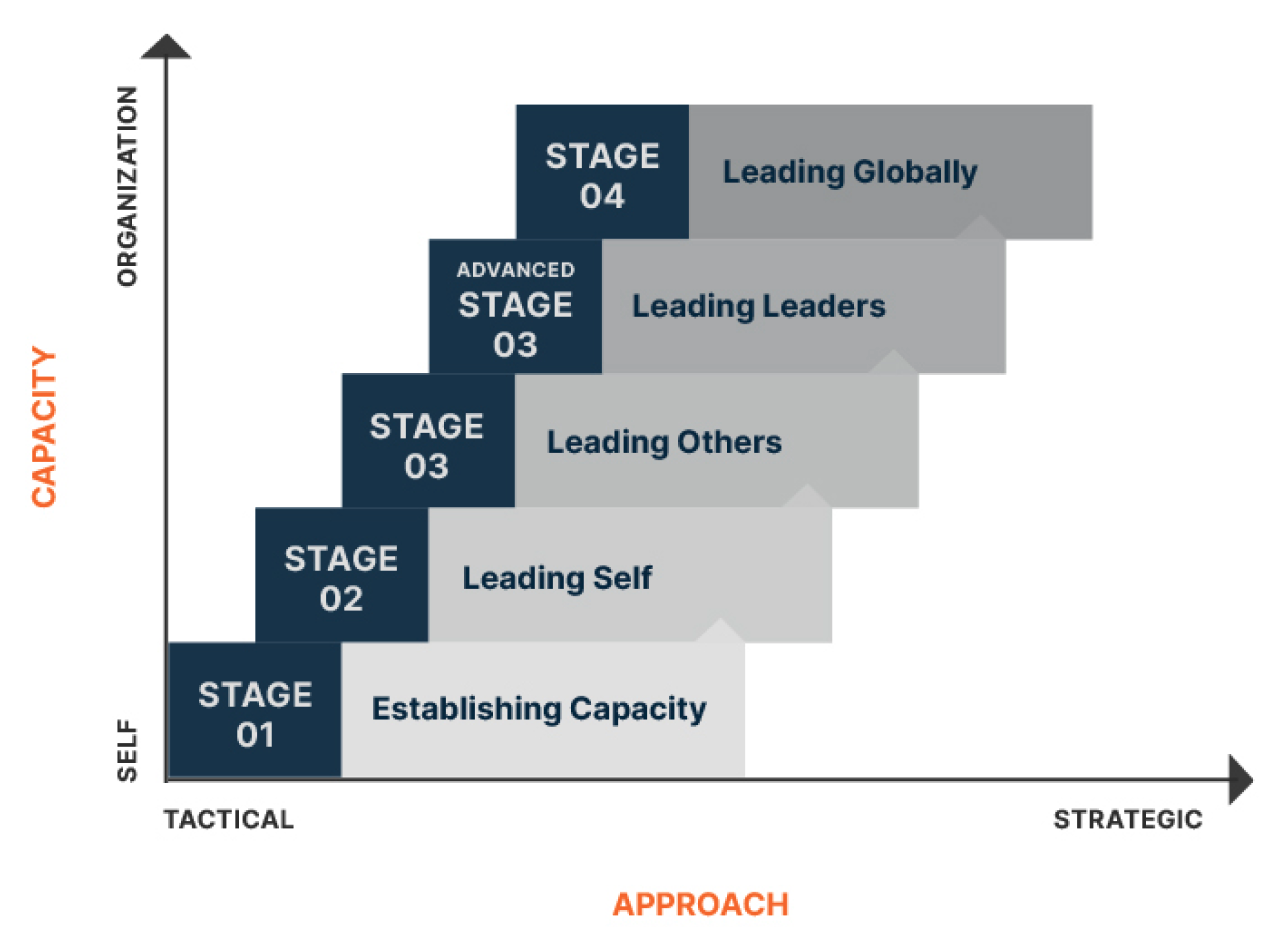


Establishing Capability – Helping & Learning
In this Stage a person is learning their new position. They accept direction from others, learn basic skills, work on smaller tasks and demonstrate future potential. These are typically new hires and people coming into a new assignment.

Managing Self – Developing Expertise
In this Stage a person is an individual contributor that demonstrates full competency in their assigned role. They develop technical and professional skills in an area of expertise, work with minimal supervision and adopt professional standards for their area of expertise.

Leading Others – Contributing Through Others
In this Stage a person is directing the work of others. They may be a leader with direct reports or an informal leader who has no formal management responsibility but is still expected to lead a team. Their focus shifts from narrow (i.e. specific expertise) to broad (i.e. organization expertise). A person in this Stage makes sense of the work, organizes and directs others, builds strategic relationships, focuses on continuous improvement and develops self and others.

Leading Others – Helping Leaders Succeed
In this Stage a person acts as the bridge between organizational initiatives and the people who lead teams and work groups. They are most likely to have exclusively managerial responsibilities; their direct reports typically being group or team leaders. They focus more broadly in this Stage than in Stage 3. A person in this Stage deploys resources, manages boundaries between groups, selects and develops first-line leaders and fosters a strategic mind-set for their direct reports.

Visioning Broadly – Leading Through Vision
In this Stage a person is creating and deploying the overall business strategy through a team of direct reports responsible for major functions of the organization. Their focus is strategic, not tactical, and often looks at how to best position the organization to capitalize on changing market conditions. A person in this Stage provides organizational direction, develops new ideas, directs resources toward specific goals and represents the organization to the market.

The crucial finding from the Dalton and Thompson research was that the meaning of high performance fundamentally changed from one Stage to the next. The approach and behaviors that made an individual successful in one Stage would unfortunately guarantee his or her demise in the next. To be successful, individuals had to undergo a transition that required a significant change in perspective, behaviors, tasks, relationships and skills. They also discovered that these transitions to higher levels of impact did not occur automatically based on age, education, experience, or movement into new positions.
The most difficult of these transitions is the one from a Stage 2 Specialist, acting as individual contributor, to a Stage 3 Leader, who contributes through others. At least 70 percent of all professionals never really understand these new expectations, and therefore the perceptions of others, change dramatically when one moves from Stage 2 Specialist to Stage 3 Leader. When people do not successfully make the move to the expected higher levels of impact, their individual performance as a leader and the overall performance of their organization both suffer.
Download Whitepaper As PDF
A Classic Professional
Development Irony
Typically, individuals who are highly successful in Stage 2 are those selected to move into the Stage 3 Leader role. Every organization selects their new leaders from the “cream of the crop”. The compelling logic is that the highest performing individual contributors will make the best leaders. These individuals are then given basic management skill development in areas such as coaching, delegation and conflict resolution.
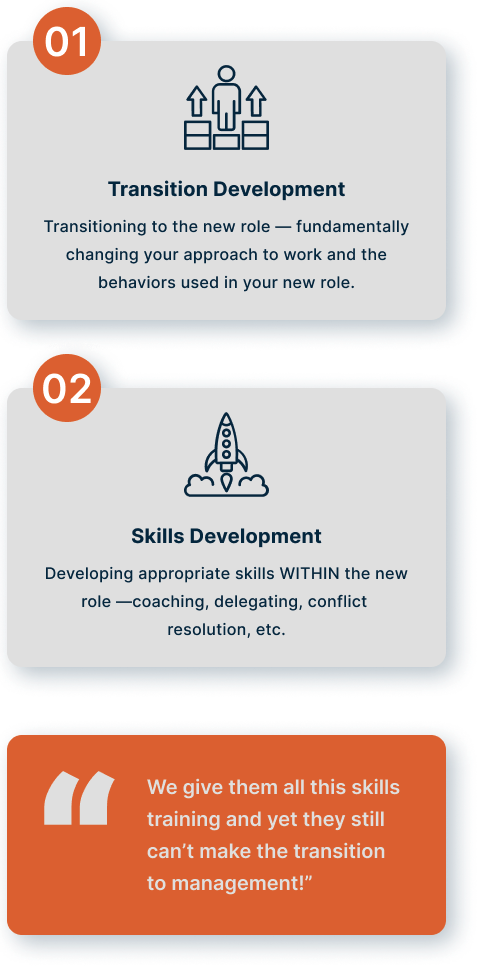
What’s consistently overlooked is assistance in the transition from Stage 2 to Stage 3 and a clear awareness of the changes leaders will be expected to make in: (a) their approach to work; and (b) the behaviors they exhibit in their new higher impact role. At Emerge Leadership Group, our research shows quite clearly that for strong individual contributors to successfully transition into higher impact leader roles, they require a two-phased development approach:
Most organizations focus on Step 2, mastery of management skills. However, the behavior and focus change required in Step 1 is much more crucial and difficult, yet often not even addressed. That is why people complain “We give them all this skills training and yet they still can’t make the transition to management!” Not providing fundamental transition development is like building a house with no foundation. For a while the house looks fine (i.e. initial period after someone is promoted into a leadership role), however, when subjected to the first heavy winds (i.e. major business challenges) the house will collapse (i.e. perceived poor performance). The lesson seldom learned in organizations is that without a strong foundation of transition development, management skills training will have limited impact and expected high impact leadership performance will not be realized.
An additional negative outcome of the missing transition development is declining engagement in the workforce. Leaders that have not fully transitioned behave in ways that destroy an environment of engagement. A leader that has fully transitioned understands how to build an environment of engagement through employee participation, involvement, respect, and commitment to organizational goals and purpose.
Schedule a 15-20 minute consult with an Emerge Consultant to discuss the gaps in your organization’s leadership approach.

The Challenge: Changing Approach and Behaviors
The root cause of the problem of not effectively transitioning individual contributors to management or informal leadership positions can be solved. However, most companies just address the symptoms and never get to the root cause of the problem. As Linda Hill, a Harvard professor, suggested in her book, Becoming a Manager:
 Listening to managers it becomes clear that the transition to manager is not limited to acquiring competencies and building relationships. Rather it constitutes a profound transformation, as individuals learn to think, feel, and value as managers.”
Linda Hill
Individual contributors must make the psychological shift to manager first by changing their perspective, approach and behaviors from narrow specialization to a broad understanding of major segments of the organization. Making the full transition requires an assessment of the individual’s current Stage of impact and what behavior they need to change in order to achieve higher levels of impact. Their progress then needs to be measured. Once they are getting traction towards higher levels of impact, the basic skills needed to manage effectively (i.e. team building, delegating, coaching, etc.) can be taught and will be applied more from a Stage 3 rather than a Stage 2 approach.
Download Whitepaper As PDF
Why Companies Don’t See the Problem
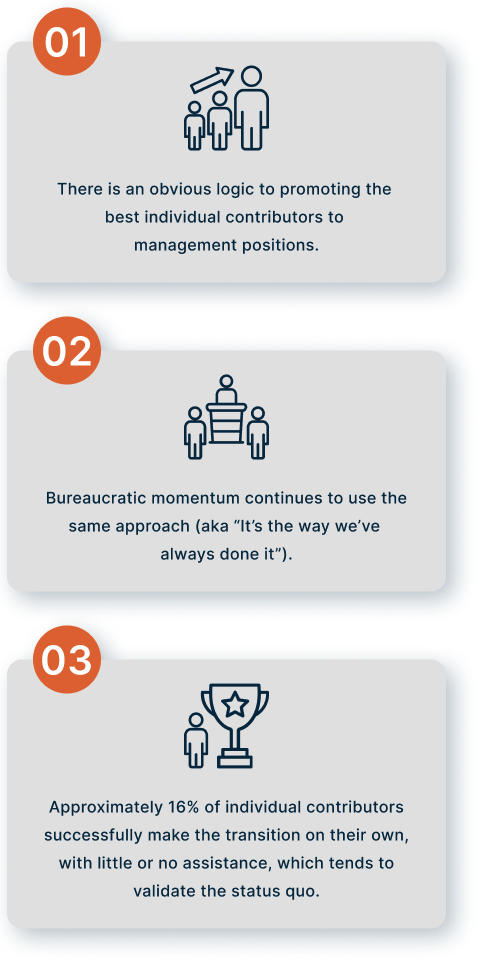
As mentioned earlier, most companies see the symptoms but not the root cause of the transition problem. The symptoms include ineffective teams, high turnover, low morale, higher costs, lower profits and a lack of innovation. The much less obvious root cause is individual contributors who don’t change their approach and behaviors to those commensurate with fully-transitioned high-performing leaders. In addition to not understanding the root cause, companies fail to see the importance of these transitions because:
Not Seeing the Problem has Huge Implications
Not effectively helping people transition from Stage 2 Specialist to the higher impact role of Stage 3 Leader can be directly linked to poor financial performance of many organizations. In her book, “Becoming a Manager: How New Managers Master the Challenges of Leadership”, Linda Hill stated: “The human and financial costs are staggering for both the organization and those who fail to make the transition to manager.” This issue has major significance for organizations. In our recent study of more than 100 companies, we found that 47 percent of all managers are seen as operating as individual contributors.
Another 37 percent of all people with the “manager” title are perceived as stuck somewhere in the transition to manager and are making little or no progress. Linda Hill’s study and our own experience tell us that the transition usually takes three-to-five years to complete unless individuals get significant help. In Dalton and Thompson’s original study, an individual contributor who fully transitions into the role of leader will more than double his or her contribution to the organization. If 84 percent of all leaders in today’s organizations have not yet fully transitioned to the role of leader, then even the most conservative calculation of the costs is significant.
Schedule a 15-20 minute consult with an Emerge Consultant to discuss the gaps in your organization’s leadership approach.
The Transition Process to Higher Impact
There is a process and a set of tools that can help even experienced leaders fully transition into the manager role. The process can be divided into the several steps:

First, leaders who are acting as individual contributors need to understand how to make the transition to the leader role. They need to know how to make the shift in behavior and approach that is required to complete the transition. A key result of this type of development is a personalized transition plan created by each manager to focus his or her efforts, establish a time frame for completion and create accountability.

A critical tool in the transition development process is an assessment tool to determine the gap between an individual’s current and required behaviors to fully function as a Stage 3 Leader. This assessment must: (a) include prescriptive recommendations for changing the approach to work and the required behaviors for leaders; and (b) be administered before and after transition development to create accountability and measure progress.

One of the most critical steps in this process is for each manager to take on a new project or responsibility. This project should address a specific high-value business need and be sufficiently complex that it is more than what the leader can accomplish alone. Dalton and Thompson found the most important catalysts for helping to facilitate a successful transition from an individual contributor to leadership role were job assignments or responsibilities that would help people grow and develop without overwhelming them.

Leaders of people making the Stage 2 to Stage 3 transition must: (a) support the individual’s transition plan; (b) remove barriers; (c) offer resources; and (d) provide coaching and protection. When this process is clearly articulated and followed in a disciplined way, individuals who are leaders in title only can complete the transition to becoming high-impact leaders. In the process, they deliver increased business results, realize higher personal job satisfaction, develop greater capability in others, and build a much broader network of support.

Conclusion
By using these tools and supporting this process to help people who lead others, organizations will be able to ensure that their individual contributors are able to develop into high impact leaders as efficiently, effectively and rapidly as possible. Helping people transition is critically important since every organization needs highly effective leaders to compete successfully in today’s lean and competitive environment.
Download This Whitepaper As a PDF for Quick Reference
Download Now