
Maximizing Your Impact as
a Manager of Managers
Becoming an Organizational Leader
Schedule a 15-20 Minute Consultation
“The influence of each human being on others in this life is a kind of immortality.”
– John Quincy Adams

Introduction
In the ever-changing and demanding environments that currently face organizations, leaders who make a dynamic impact are needed to create and drive positive business results.
Among those leaders, managers of managers perform an increasingly vital function, serving as a bridge between the highest-level direction and the day-to-day work of the organization.
With duties ranging from selecting and developing first-line leaders to fostering a strategic mind- set, managers of managers are focused on longer-term activities that will drive success through other people. In that sense, these high impact leaders have the ability to build a leadership legacy in the organization through the first-line leaders they select, nurture and develop.
For managers of managers to maximize their impact and as a result create a legacy of leadership in their organization, they need to understand and fulfill the expectations of their roles as leaders. The role requires the manager to take on many responsibilities, including establishing an environment that allows team members to flourish.
The expectations for managers of managers are often difficult to fully comprehend and even more difficult to achieve.
Emerge Leadership Group recognizes the challenges and responsibilities that accompany this role and has developed the Maximizing Your Impact Workshop for Managers of Managers to assist in creating the highest possible value for the effort put forth.
The workshop is designed to help managers become more effective in their role as a leader in order to maximize their impact to their organization.
Schedule a 15-20 minute consult with an Emerge Consultant to discuss the gaps in your organization’s leadership approach.
The Importance of Leaders
Managers of managers have many expectations placed on them by their organizations, including setting direction, establishing productive environments, providing the tools and means necessary to achieve organizational goals and engaging team members in a manner that inspires employees’ commitment in reaching goals.
Organizations experience tremendous impact depending on the extent to which managers of managers do or do not fulfill the expectations placed on them. Through selection and development of leaders, managers of managers have a direct and lasting impact throughout their organization.
Studies (1) show that organizations and their leaders must take leadership development seriously, as several important business outcomes are directly and significantly impacted by the quality of leadership.
Three major impact areas are turnover, customer satisfaction and net profits.
One of the most common reasons people leave their jobs is tied to the nature and quality of the relationship between the individual and his/her manager (2).
Turnover rates are tied directly to the effectiveness of leaders. Leaders in the top ten percent of effectiveness experience the lowest annual loss, with leaders at other levels of effectiveness experiencing higher turnover rates (3). Good leaders retain good talent for their organizations.
Customer satisfaction is also influenced dramatically by the effectiveness of a leader. Leaders in the top twenty percent of effectiveness experience higher customer satisfaction scores than all other leaders (4).
Good leaders also increase profitability for organizations. The net profits of groups
have a significant relationship to the quality of their leaders.
The top ten percent of leaders have been found to produce more than double the net income of the other ninety percent of leaders (5).

 Motivate them, train them, care about them, and make winners out of them … they’ll treat the customers right. And if customers are treated right, they’ll come back.”
J. Marriott Jr.
Download Whitepaper As PDF

Setting The Stage
As people grow and develop over the course of their career in an organization, expectations also change over time.
The Stages of Impact track the steps employees make along their career path. Stage 1 finds an employee demonstrating a willingness and ability to learn and follow while establishing capability in a new role.
In Stage 2, the individual is able to manage himself/herself, establishing the ability to be a solid producer without constant supervision.
Thinking first and foremost of the success and good of others before self is the essence of Stage 3, as individuals make what is best for the organization the focus of their efforts.
An individual in Stage 3 might not have any formal leadership responsibility, but may be looked upon as an informal leader.
Managers of managers find themselves in Advanced Stage 3, focusing on longer-term activities that will drive success through other people. Becoming fully integrated into Advanced Stage 3, leaders must rely more on people-related skills than the technical abilities that helped get them promoted.
Transitioning from Advanced Stage 3 to Stage 4 requires leaders to develop the ability to look beyond individuals and groups, shifting attention to the longevity and success of the organization as a whole.
Becoming successful as a manager of managers requires a shift in focus and the approach to work, placing more emphasis on the people you lead.
Among the major points of emphasis that need to be addressed are focusing on team results rather than individual results, taking calculated risks and working on riskier assignments rather than limiting personal risk or exposure to risk, taking on larger, more ambiguous projects instead of smaller, more contained projects and working on multiple-discipline projects instead of single-discipline, single-focus projects.
Schedule a 15-20 minute consult with an Emerge Consultant to discuss the gaps in your organization’s leadership approach.
The Z.O.N.E. Approach
Research demonstrates that the manager plays a critical role in the development and maintenance of employee engagement (6).
The Emerge Leadership ZONE Engagement Model identifies four elements for employees to focus on, resulting in the opportunity for more engaged experiences in the workplace.
When the four elements of The ZONE come into alignment, the possibility of a highly-engaged work experience is the result.
Each of the individual elements can be powerful at producing meaningful results, but it is the overlap and alignment – when all four elements are present at one time – where engagement truly happens.
As the manager of managers, you build engaged environments by helping your employees and the people reporting to them align their own ZONE elements.

The ZEAL or passion employees bring to their work. This is critical to achieving engagement. Employees must periodically be involved in work that interests them deeply or they will not remain engaged.

What the ORGANIZATION needs done in order to be successful. Being passionate about work is not enough. In order for work to be deemed valuable, it must be directly connected with the organization’s needs.

The NETWORK of relationships employees have or need to be successful in the workplace. To remain engaged, individuals must develop and maintain a productive network of workplace relationships.

The EXPERTISE or talent employees have or need to accomplish their work. It is important for individuals to have a realistic understanding of where their talent lies. It is just as important to understand what skills the individual will need to develop in order to move forward and be successful in the future.
Download Whitepaper As PDF
Meeting expectations
Leaders in Advanced Stage 3 are expected to lead and provide direction on a higher and broader level.
To be effective as a manager of managers, leaders need to be removed from the day-to-day work, focusing on longer-term activities that will drive success through others.
There are five Key Accountabilities that leaders in Advanced Stage 3 must focus on to be successful.

5 Key Accountabilities:
Schedule a 15-20 minute consult with an Emerge Consultant to discuss the gaps in your organization’s leadership approach.
Managing Time
To be an effective leader, managers of managers must take an overall view of the resources at their disposal and utilize them with a focus on achieving the strategic goals of the team and organization.
Time is a major resource that managers of managers need to allocate accordingly. Interruptions and demands on your time can combine to derail your schedule, leaving little time for activities that would make the biggest impact on your team and organization.
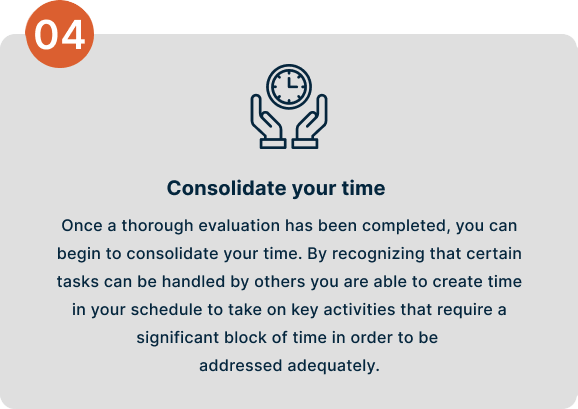
By following a simple four-step process, you can discover how your current allocation of time and activities may be improved:
 Effective [leaders], in my observation, do not start with their tasks. They start with their time.”
P.F. Drucker
Download Whitepaper As PDF
Breaking Down Silos
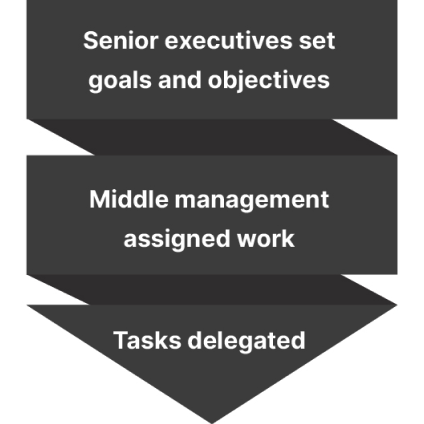
Those at the highest level of management would like their organization to operate as one large silo, where all departments and employees cooperate together in a contained environment, sharing information, ideas and resources to meet clearly defined goals and objectives.
In reality, organizations are structured into individual functions or departments. A top-down communication flow creates a silo mind-set, where people view those outside their own team or group as “competition” rather than seeing them as valuable resources for collaboration. This mind-set can stifle the innovation and productivity that organizations need remain competitive and can contribute to low levels of engagement.
Managers of managers can go a long way toward providing a remedy for this situation by opening boundaries. As work processes and products often need to be touched by other teams or departments within the organization, fostering a free-flow of ideas, information and resources can expedite the progress of these work elements.

The legacy of heroes is the memory of a great name and the inheritance of a great example.”
Benjamin Disraeli
Building a Legacy
By both selecting and then developing the next generation of leaders, managers of managers create a lasting legacy of leadership while helping to determine the success of the organization.
The selection of these first-line leaders, when properly done, seeds your organization’s leadership field. In most organizations nearly every senior leader received his or her first leadership assignment from someone who was a manager of managers.
There are two general approaches to selecting first-line leaders: promotion from within the group and hiring from outside the group and/or organization.
When promoting from inside the group, successful managers of managers will find ways to observe potential candidates as they perform leadership tasks.
The Emerge Leadership Group Leadership Potential Matrix is a tool that can be used to identify those that are ready to take on a new leadership assignment.
The Leadership Potential Matrix will allow managers to group individuals in the talent pool, place them along a performance continuum from “Below Standard” through “Exceeds Standard” and while also taking into account where each individual is in terms of their Stage of Impact.
The Leadership Potential Matrix will allow managers of managers to identify potential leaders who are performing at a high level and taking a Stage 3 approach to their work, making them candidates to become first-line leaders.
When promoting from within the group isn’t feasible, filling the position from outside the group becomes a necessity.
Behavioral interviewing is an effective way to identify appropriate candidates by using questions that can help you discover whether or not the individual has first-line leader attributes.
Questions should allow you to gauge the candidate’s ability to lead, allowing you to find someone who has a passion for getting things done while taking a Stage 3 approach in how they work.
Schedule a 15-20 minute consult with an Emerge Consultant to discuss the gaps in your organization’s leadership approach.
Developing First-Line Leaders
The foundation of a great team lies in a manager’s ability to effectively develop their people. Effective leaders are committed to developing themselves and others. Allocating time and energy to this development will bring about positive results.
Managers of managers have more influence than anyone else in an organization to either assist or hinder first-line leaders as they make their own leadership transition.
Managers of managers must help their first-line leaders “let go” of their Stage 2 ways –managing themselves – and begin to work in a Stage 3 manner by contributing through others.
Making a transition is a fundamental psychological and behavioral shift in what you care about, what you spend your time doing and what gives you the deepest satisfaction at work.
Emerge Leadership Group studies show that the number of leaders who have fully transitioned into their new role from behaving as individual contributors is less than 20 percent. More than 80 percent of leaders are either taking a Stage 2 approach to their work or are stuck somewhere in transition.
Managers of managers can provide a bridge to transition for first-line leaders by providing assignments and projects that allow them to practice the skills that lead to that transition.
The steps along the bridge to transition include creating meaningful assignments for individuals strategically delegate those activities, provide coaching and training when needed and hold them accountable for results.

… It becomes clear that the transition to manager is not limited to acquiring competencies and building relationships. Rather it constitutes a profound transformation, as individuals learn to think, feel, and value as managers.”
Linda A. Hill
Download Whitepaper As PDF
Fostering a Strategic Mind-Set
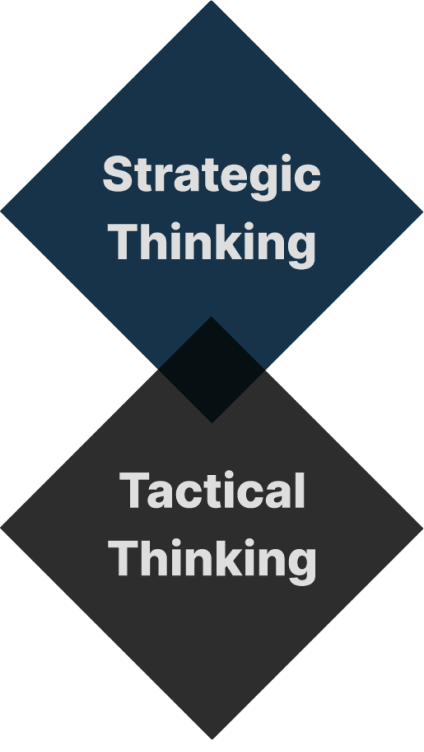
Effective leaders display the ability to balance strategic thinking (far-reaching) along with tactical thinking (day-to-day). Managers of managers need to be more strategic in their approach to work while also getting their team to work that same way.
Strategic improvising is one way to foster a strategic mind-set by encouraging a level of innovation and risk-taking. Encouraging your direct reports to make decisions in real-time and supporting them without micro-managing is essential to their growth and development while also helping to create a more engaged team.
The MBRS Model (Momentum, Barriers, Resistance, Support) is a way to support innovative initiatives. It can be used to assist leaders in identifying and responding to potential issues that may impact the success of an initiative.
Momentum describes the forces that inspire or drive the initiative and may include competition, legislation/regulations, customer needs or a life-changing event.
Barriers include the non-people related factors that may block the initiative and include systems and processes and performance appraisals and feedback.
Resistance describes the people-related factors that may block the initiative, such as beliefs, attitudes, behaviors and politics.
Support includes the factors that help change to occur or provide evidence of success, such as performance appraisals and feedback aligned with the initiative.
By keeping these variables in mind, you help to ensure that your team thinks through their ideas before trying to make them happen, helping to ensure the likelihood of success.
Schedule a 15-20 minute consult with an Emerge Consultant to discuss the gaps in your organization’s leadership approach.
The Emerge Process
For managers of managers to take on and fulfill the expectations placed on them they must first recognize and accept those expectations.
The Emerge Leadership Group Maximizing Your Impact workshop for managers of managers is designed to help managers become effective in their role as a leader so they can maximize their impact.
The training and tools provided in the workshop are designed for leaders to use again and again during their careers.
Through workshop training, individuals learn the following:

Download This Whitepaper As a PDF for Quick Reference
Download Now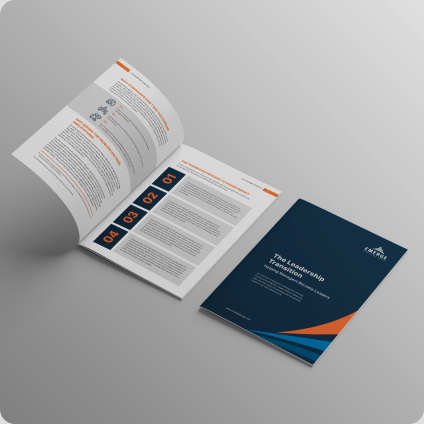
Emerge Leadership Group is a research-based assessment and development organization that focuses on helping individual contributors maximize their impact by more effectively transitioning them into leadership roles.